Health Carrier Directed Journey Platform & Design System
Overview
Summary
Led design on a health carrier directed journey authoring and management platform as well as building up a design system in parallel.
My Role
Lead Product Designer
Responsibilities
Design | Prototyping | UX Roadmapping
Worked with
Engineering | Product | Marketing
Company
Bloom
Artifacts created
Wireframes | High-fidelity designs | Interactive prototypes | UX Roadmaps
Tools
Figma | FigJam
As Lead Product Designer at Bloom, I led the design of a new platform that transforms how Medicare health carriers author and manage member journeys — spanning 200+ screens and a supporting design system.
The Problem
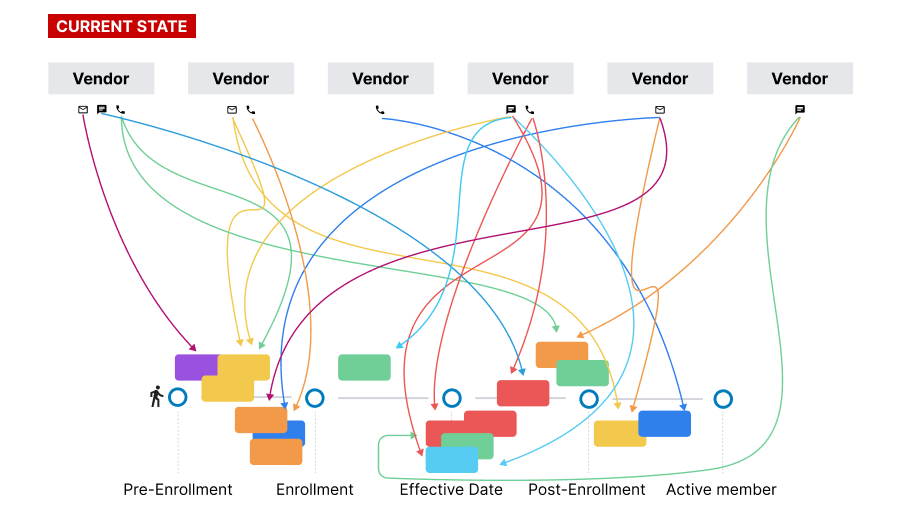
Conceptual diagram showcasing the chaotic experience members have throughout the plan lifecycle, constantly receiving outreaches from multiple vendors without any coordination.
At the start of each plan year, existing and prospective Medicare members enroll in Medicare Advantage or other Medicare health plans. Once enrolled, carriers deliver communications via email, SMS, IVR, and other channels to drive member actions, such as opting into notifications, downloading the carrier app, or completing a health risk assessment.
These communications, however, are managed by different teams and vendors with little coordination. Members are often overwhelmed with duplicate or poorly timed messages, while carriers lack visibility and control across vendors. The result is a poor member experience and operational inefficiencies for the business.
The Solution
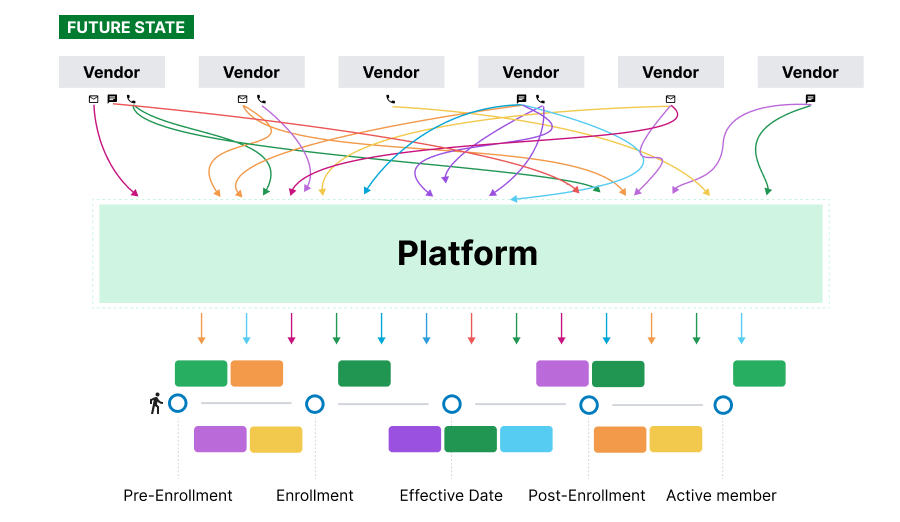
The platform acts as a buffer between the member and vendors working on behalf of health carriers. The platform organizes the vendor outreach chaos resulting in coordinated member outreaches. Members experience a much more ordered set of outreaches throughout the plan lifecycle creating a significantly improved member experience.
We designed a new platform that allows carriers to create orchestrated, sequenced journeys, ensuring members receive timely, relevant outreaches while giving carriers centralized control and reporting across all vendors and channels.
My Role
In my role as Lead Product Designer, I partnered with engineering, product, and other stakeholders to design the platform’s core workflows from concept through handoff. Key areas I designed included:
- Journey creation and management
- Member cohort creation and management
- Interactive dashboards and reports
- Administrative tools
- User management features
- Authentication flows
In addition to designing these workflows, I:
- Applied system-level thinking to design a cohesive, extensible framework across flows.
- Facilitated cross-functional alignment through design reviews and demos.
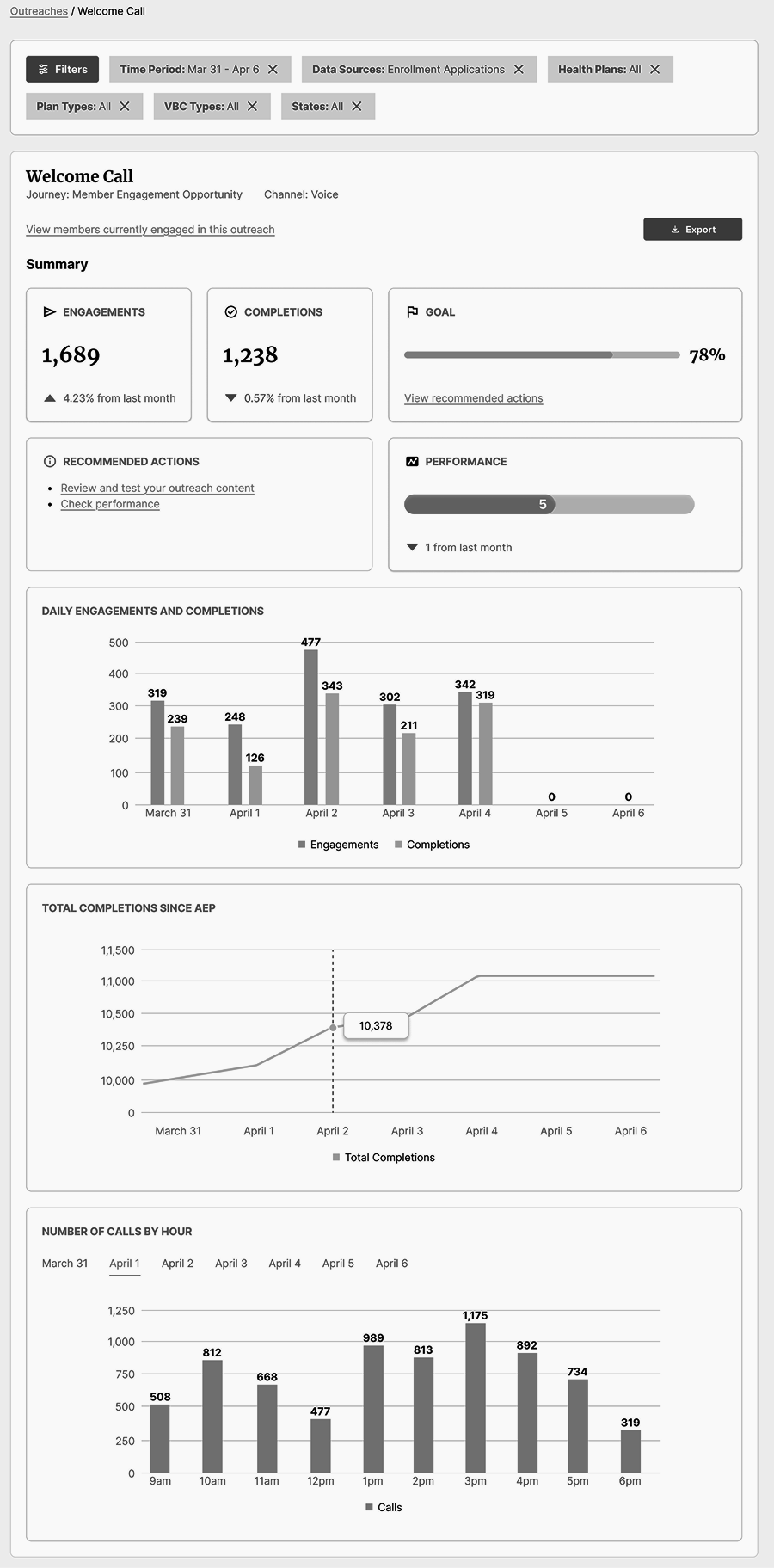
An early design concept showcasing dashboard-like content that would appear when a health plan user navigated to an outreach’s performance page.
The Process
We worked in an agile environment with 2-week sprints, where I aimed to keep design 1 - 2 sprints ahead of development. My design process combined internal research, iteration, and prototyping:
- Partnered with product to shape requirements in parallel with the designs.
- Conducted internal stakeholder interviews and expert reviews to validate concepts.
- Built interactive Figma prototypes that clarified complex workflows, enabling early feedback, consensus, and smoother engineering handoff.
- Iterated through design cycles based on stakeholder input and usability considerations.
- Created lightweight documentation and reusable patterns that smoothed developer handoff and accelerated implementation.
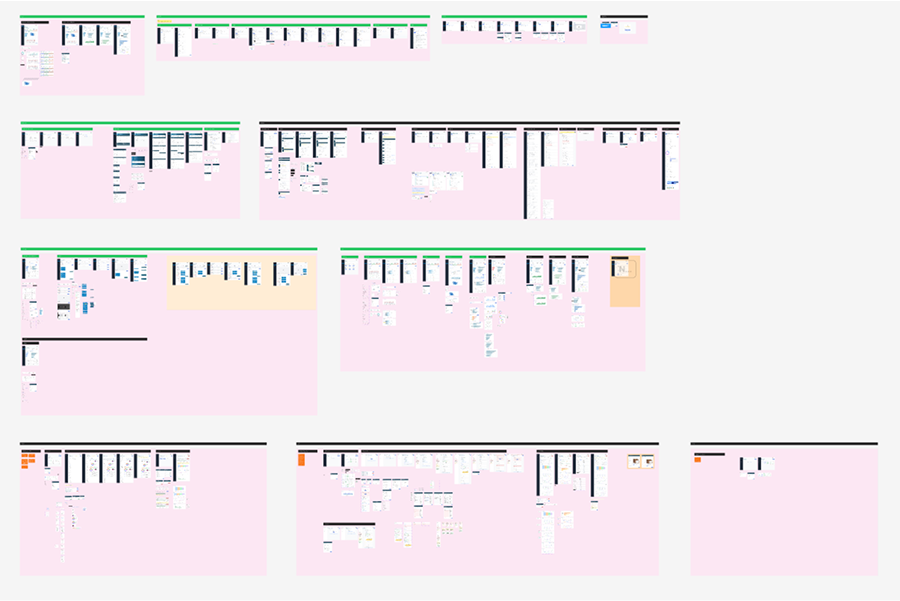
A high level view of the number of screens designed for the various flows implemented in the platform. This screenshot shows less than 1/3 of all screens created, not including conceptual design exploration screens.
The Design System
In parallel with designing the platform’s core workflows, I built a design system to ensure standardization, flexibility, and faster delivery. The system included foundations (typography, spacing, colors, shadows), reusable components (buttons, inputs, panels, modals), and patterns (navigation, tables, forms). Centralized in a shared Figma library, it cut design time, ensured cohesion, and provided developers with clear specifications.
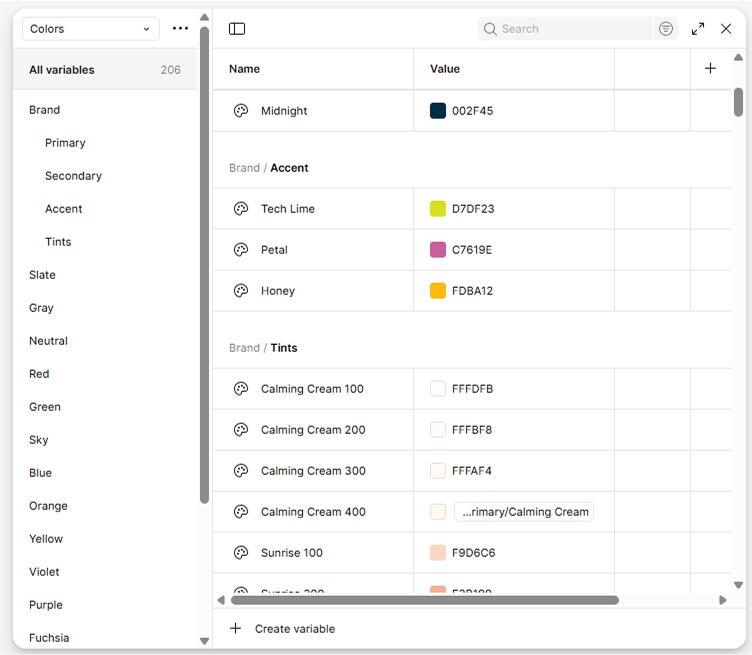
Color organization as part of the design system.
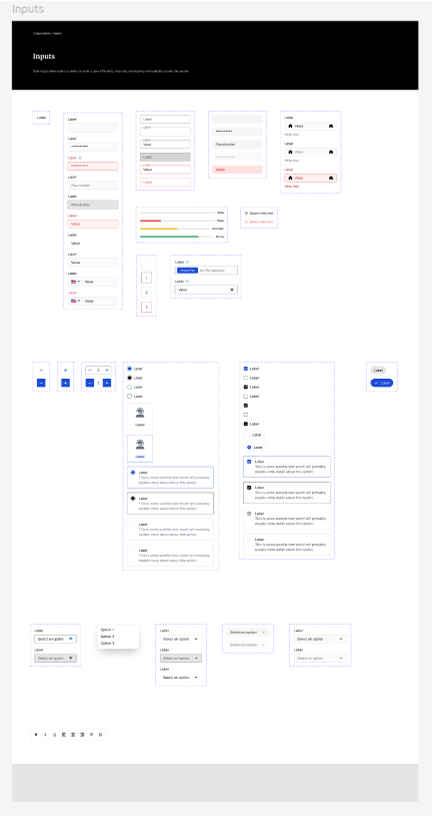
Snippet of Input components, many with variants based on state or condition.
Outcomes
The work I delivered set the foundation for both near-term implementation and long-term extensibility:
- Established a scalable product backbone through 200+ designs, prototypes, and a supporting design system, ensuring consistency across all workflows.
- Minimized design–development gaps by embedding with engineers, reducing rework, improving feasibility, and shortening delivery cycles.
- Accelerated leadership buy-in using interactive prototypes to clearly communicate critical flows, helping secure consensus on product direction and speed up decision making.